It starts with the solution, not the crime
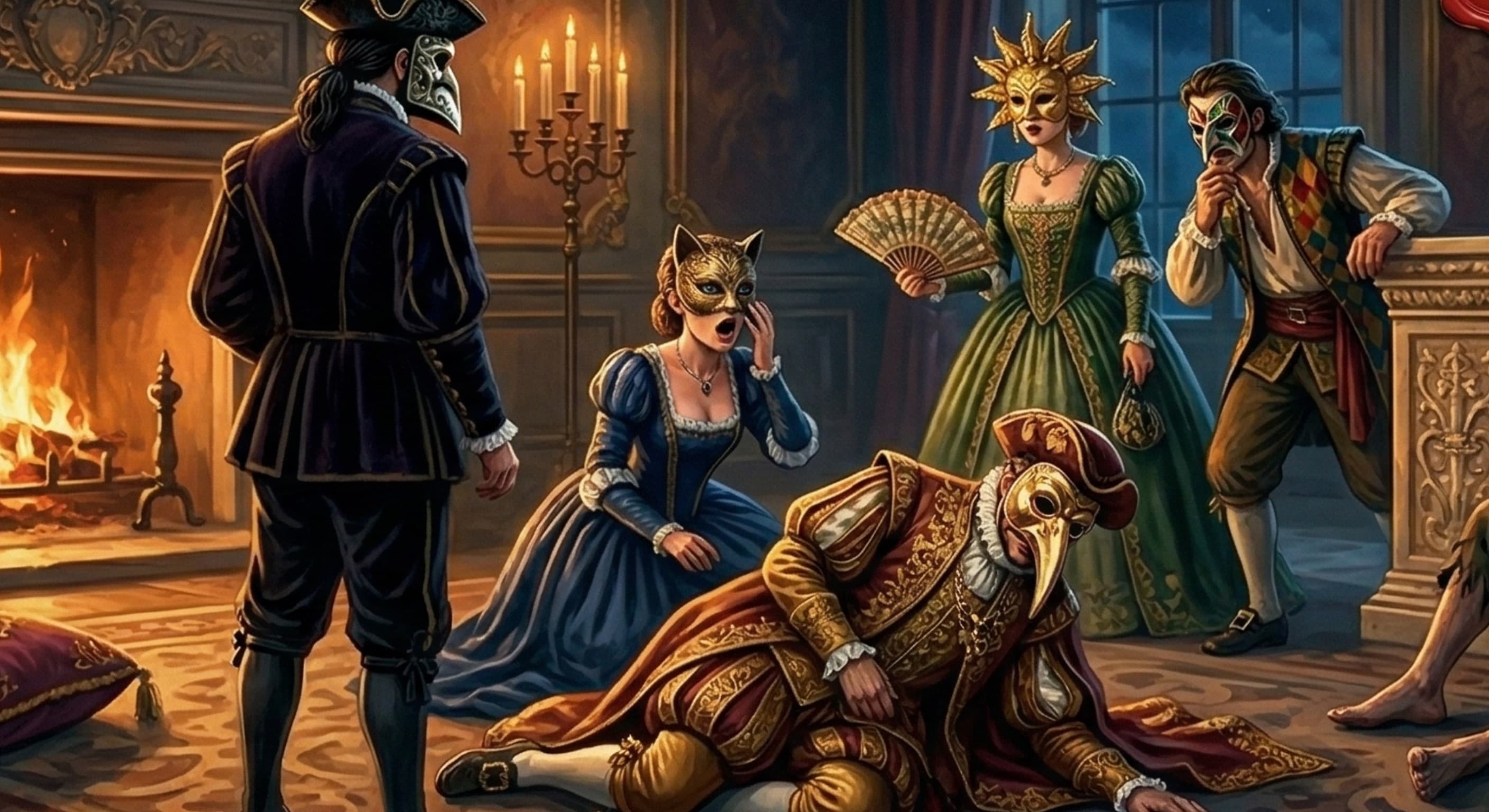
The first thing written is the last thing revealed. A scenario begins with a single paragraph stating who did it, why, how, and exactly when, down to the minute. Everything else is reverse-engineered from that paragraph, which is why it has to be settled before any character exists. Writers who start with an atmospheric setting and hope a culprit emerges produce scenarios that collapse in the third round, because the evidence ends up pointing everywhere and nowhere. The solution paragraph also has to satisfy a hard test: the motive must be strong enough that a reasonable person would understand it, and the method must be physically possible given where everyone was. Once that paragraph is locked, the writer builds a minute-by-minute timeline of the entire evening of the crime, tracking every character position, including the innocent ones. That timeline is the skeleton of the whole product and most of the later work consists of consulting it.
Building a cast where everyone is guilty of something
The design rule that matters most is that no character may be innocent of everything. If seven suspects are clean and one has a secret, the group solves the case in twenty minutes by looking for whoever is uncomfortable. So each character receives a secret that is genuinely damaging but not the murder: an affair, a theft, a lie on a resume, a debt, a forged signature, a second family. Each of those secrets produces the same defensive behavior as guilt, which is what makes the room usefully confusing. Every character also needs a plausible motive against the victim and a weak point in their alibi. The cast is then arranged as a web rather than a list: A owes money to B, B is protecting C, C saw something D wants buried. Those connections are what generate conversations on the night, because each one gives two players a reason to seek each other out.
The information map: who knows what, and when
The hardest document to build is not the story. It is the grid tracking every fact in the scenario against every character who holds it and the round in which they are told to release it. Each essential fact needs at least two independent routes to the players, because if a single character holds a critical clue and that guest spends the evening in the kitchen, the case becomes unsolvable. Redundancy is what makes a scenario robust. The grid also enforces pacing. Round one releases relationships and motives. Round two releases contradictions, which is where the alibis stop agreeing with each other. Round three releases the physical evidence that eliminates all but one suspect. A writer checks the grid by reading it column by column, asking what each player knows at each moment, and whether that player has enough to do. A character with nothing to reveal in round two is a design bug, not a quiet personality.
Writing clues that are fair but not obvious
A clue has to be understandable to a non-specialist, meaningful only in combination with something else, and impossible to dismiss as decoration. That combination is harder than it sounds. A train ticket with a time on it is meaningless alone and devastating next to a statement claiming someone was elsewhere. So clues are written in pairs or triples that only matter when assembled, and the assembly work is what the players are actually being sold. Two failure modes are constantly guarded against. The clue that solves everything on its own, which ends the evening early and makes the other materials pointless. And the clue that requires specialist knowledge, chemistry, period railway timetables, obscure heraldry, which is unfair because the group cannot reason its way there. The fair play principle inherited from Golden Age detective fiction is the standard: every piece the solution depends on must reach the table before the accusation round.
Rounds, pacing and the shape of the evening
A scenario is not just a mystery, it is a schedule. Three rounds is the standard structure because it maps onto how a real evening behaves: introductions, complication, resolution. Round one runs long, around thirty-five minutes, because people need time to settle and meet each other. Round two is the longest and the densest, since it carries the contradictions. Round three is deliberately shorter, around twenty-five minutes, to create urgency at the end. Between rounds sit the bridging passages, which the host reads aloud, and which exist to reset attention and justify handing out new material. Writers also build in what might be called recovery mechanisms: prompts in the host guide naming which characters should talk to each other if the room goes quiet, and optional characters flagged as removable so a cancellation does not break the plot. Most of that work is invisible on the night, which is the point.
Playtesting, where scenarios are actually made
No scenario survives its first play unchanged, and any writer who claims otherwise has not run one. Playtests reliably expose four problems. Players solve it far too early, usually because one clue was clearer than intended. Players cannot solve it at all, usually because a fact had only one route to the table and that route did not happen. A character turns out to have nothing to do for forty minutes. And a passage that read well on the page sounds wrong when spoken aloud in a room. Each of these requires a different fix: blunting a clue, adding redundancy, giving a character a new obligation, rewriting for the ear rather than the eye. Writers also watch the timing, since rounds almost always run longer than planned. The version that gets published is typically the third or fourth, and the changes between them are mostly small adjustments to who knows what and when, rather than to the story itself. The finished scenarios are on /murder-mystery-kits.
What changes when the scenario is custom
Writing a scenario around a specific group is the same process with two differences. The cast is built to fit real people rather than an abstract player count, which means characters can be sized to the personalities involved: a demanding role for the friend who will run with it, an information-heavy role for the one who would rather be asked questions than perform. And the setting can use details the group already shares, a real venue, a running joke, an in-house legend, which produces recognition laughter that no off-the-shelf scenario can generate. The technical work underneath does not change at all. The solution is still written first, the timeline still has to hold, every character still needs a damaging secret, and every essential fact still needs two routes to the table. That discipline is what separates a commissioned scenario from a fun idea that falls apart in round two, and it is what /custom-murder-mystery is built around.
Frequently asked questions
How long does it take to write a murder mystery scenario?+
For a full party scenario with ten characters, clues, a host guide and playtesting, the work is usually measured in weeks rather than days. The writing itself is a fraction of it. Building the information grid and running playtests to find the clues that are too clear or too hidden takes the most time.
Can I write my own murder mystery for my friends?+
Yes, and it is a rewarding project if you have a few weeks. Write the solution paragraph and the minute-by-minute timeline first, give every character a damaging secret that is not the murder, and make sure each essential fact reaches the table through at least two different people. Then test it before the real night.
Why does every character have a secret?+
Because a culprit surrounded by innocent people is easy to spot: they are the only one behaving defensively. Giving every character something damaging to hide means that evasive behavior proves nothing, which is what keeps the suspect list open until the final evidence arrives.
What makes a murder mystery scenario unsolvable in a bad way?+
Usually a single point of failure. If one essential fact sits with one character and that guest never gets questioned, the group cannot reach the solution no matter how well they reason. Good scenarios build redundancy so that every critical piece can arrive by more than one route.