Snow outside, burgundy velvet inside
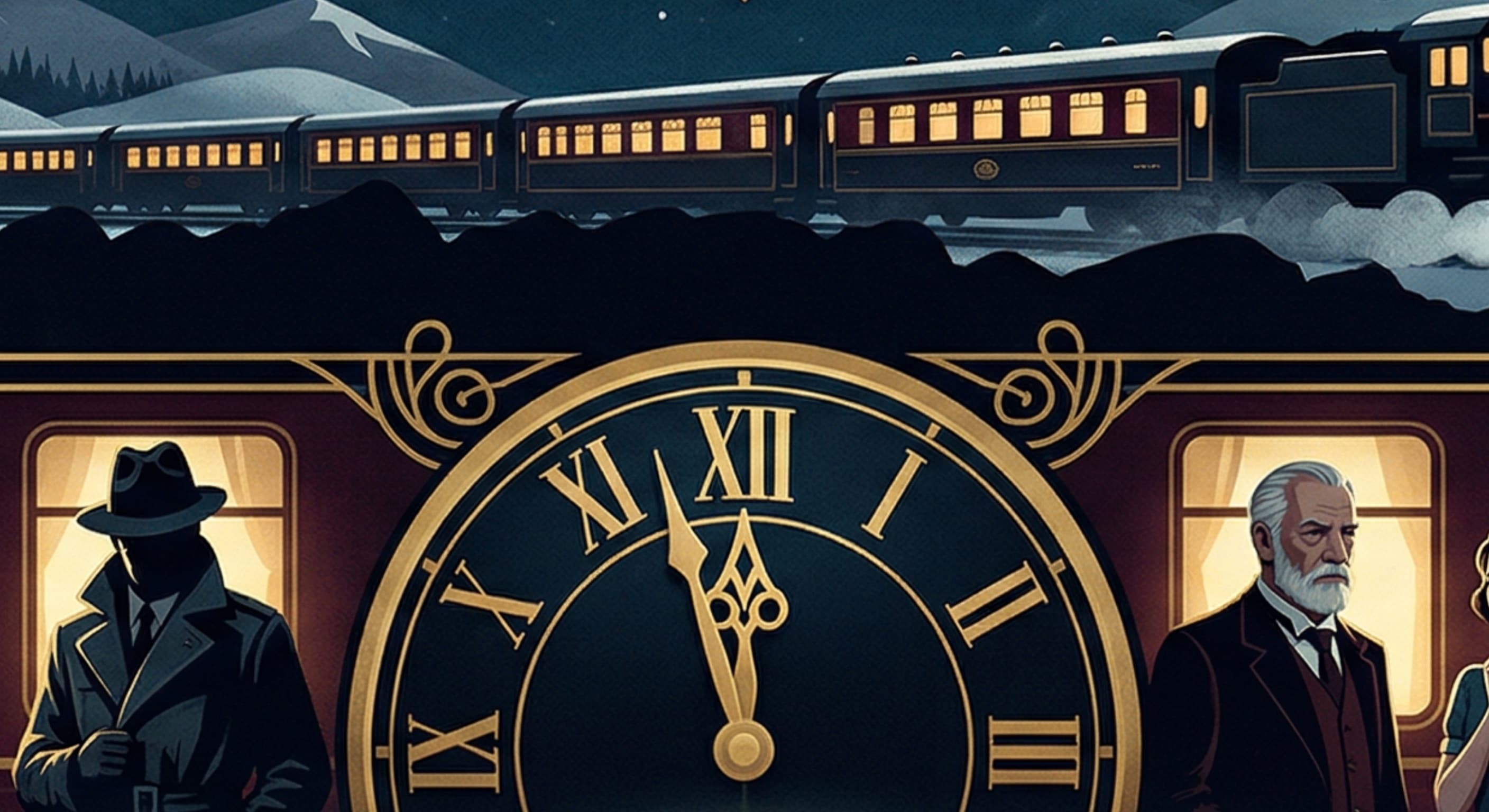
The train left Paris bound for Istanbul and has been stuck since midnight inside an Alpine tunnel, sealed in by an avalanche. Lord Reginald Ashford is found dead in his compartment in Car 7. The sleeping car is a closed box: twelve passengers and crew, no platform, no police, no way out until the line is cleared. That single constraint is what makes this scenario feel different from the others. In a manor or a casino, a suspect can drift to another room. On a train, the corridor is narrow, the compartments are numbered, and everybody walked past everybody else at some point in the night. The investigation therefore turns on geography and timing far more than on temperament: who was where, in which direction, and at what hour. The atmosphere is hushed rather than theatrical. Burgundy velvet, brass fittings, a dining car with the tables still set, a conductor's logbook. It is the most elegant scenario in the catalog and the one that best rewards a table that likes to think in timelines.
The passengers of Car 7
Twelve roles fill the carriage, and they are deliberately drawn from all over Europe so that no two players share a frame of reference. Countess Elena Volkonsky is a Russian aristocrat in exile, traveling on what is left of a name. Colonel James Pemberton is a retired British officer with a service record he does not discuss. Dr. Wilhelm Brandt is a German physician, and the only person on board with a professional reason to carry a medical bag. Lucia Ferretti is an Italian soprano between engagements. Anna Kowalski is a Polish lady's maid who sees the private side of everyone she serves. Mohammed Al-Rashid is an Egyptian businessman with contracts riding on this journey. Sir Hugo Carrington travels on diplomatic papers. And the crew are suspects too: Gaston Leduc has run Car 7 for eighteen winters and knows every creak of it, while the dining car maitre d' hears every conversation held over dinner. Each sheet carries a biography, a motive, personal goals, opening conversations, and a tiered plan for what to concede and when.
How the evening is paced
Budget two to two and a half hours of play plus half an hour of arrival and reading. You deal one character sheet per player, allow ten minutes of silent reading, read the opening aloud and announce the discovery in compartment seven. Early clues establish the physical facts of the night, which immediately puts the corridor traffic in play and stops the table from fixating on one passenger. The long middle act is open questioning, punctuated by clue releases on a schedule printed in the host guide. The last act narrows to deliberation, a secret ballot and the reveal. Because the scenario runs on times and positions, it helps enormously to put a large sheet of paper on a table and let players build the timeline in public. That is not a modification of the kit, it is how the material wants to be used. Your hosting workload stays the same as every other kit in the range: hand out paper on cue, read a few short passages, keep the solution out of sight.
The group that will love this one
Six to twelve players, best around eight to ten. This scenario suits a table that enjoys precision. If your friends are the sort who reconstruct arguments, keep notes, and quote each other back at themselves, the train will be the most satisfying kit in the catalog for them. It is also excellent for a group with strong readers, because the sheets reward players who actually work out what their own timeline implies rather than improvising vibes. Because the setting is formal and the cast is international, it plays beautifully as a seated dinner where courses punctuate the acts, which is rarely true of the more mobile scenarios. It is a strong choice for a work group as well: the analytical framing gives people a legitimate reason to be systematic rather than theatrical, and the advice on /murder-mystery-team-building transfers directly. Costume needs are modest, which helps when guests are coming straight from the office.
What to set up
The kit is a PDF delivered in seconds and printed at home. Print one character sheet per player, the clue pages, your host guide and the solution on its own sheet that never joins the pile. Fifteen minutes of preparation the day before covers it, along with the rest of the catalog on /murder-mystery-kits. For the room, think narrow and warm rather than grand. A long table, two rows of chairs, lamps instead of overheads, a dark cloth, wine glasses, a few suitcases or hat boxes if you own any. Put a large sheet of paper and pens somewhere central for the timeline. Dress is easy: a jacket and tie, a scarf, a dark dress, a pair of gloves. Anyone who owns a pocket watch should bring it. For food, a seated meal genuinely works here, and serving it in courses that match the acts gives the evening a rhythm the other kits do not offer. Instrumental period music at low volume, and no overhead lighting at any point.
Who should skip it
This is not the kit for a rowdy, mobile party. The train wants people sitting close and listening, and a group that wants to circulate with drinks will lose the thread of the timeline within twenty minutes. It is also the wrong pick if your guests dislike detail. The pleasure here is cross referencing statements, and players who tune out of anything numerical will drift. If half your table would rather solve puzzles on paper than argue in character, buy a detective case file instead. Skip it for children and for teenagers who have not read a mystery before, because the cast is large, the names are foreign to most American ears, and the reading load is real. Finally, be honest about your space. A locked train needs one room where everybody can hear everybody. If your only option is an open plan house where half the group ends up in the kitchen, choose the casino or the manor instead and save this one for a night with a proper table.
Hosting notes for the train
Give each player a compartment number and use it. Saying compartment four rather than a name makes the geography stick and makes the timeline conversation far easier. Second, write the known times on the shared sheet yourself as clues come out, so the table has one authoritative record instead of eight private notebooks. Third, protect the quiet roles: the maid and the crew hold some of the most useful observations, and a loud table will talk over them unless you invite them in directly. Fourth, hold your wild card clue for a genuine stall rather than a lull. Fifth, resist the temptation to confirm or deny theories during play, even with your face. On a scenario this precise, one raised eyebrow from the host can settle a vote that was supposed to take fifteen minutes. Read the solution aloud in full at the end, including why the other passengers are cleared. That is the part players remember.
Frequently asked questions
How many players does Crime Aboard the Orient Express take?+
Six to twelve, with eight to ten as the ideal. The PDF is trimmed to the group size you choose at checkout, so you never hand out a passenger with nobody to play them. The carriage supports a large cast easily, since a sleeping car naturally holds travelers and crew who barely know each other.
How long is the evening?+
Two to two and a half hours of play, plus about thirty minutes for arrival, sheets and silent reading. The host guide sets out act timings and tells you exactly when to release each clue, so you can hold the pace without improvising.
Does it work as a seated dinner party?+
Better than any other kit in the range. The setting is a dining car, the cast is seated by nature, and serving courses between the acts gives the evening a natural rhythm. Just make sure everyone can hear everyone, because the investigation runs on comparing times and movements.
What do I get for the price?+
A print ready PDF from $39, delivered in seconds with nothing shipped. It contains the full host guide with act timings, one character sheet per player with motive, goals and reveal tiers, the clues to hand out during the night, and the complete solution printed separately for the host.