Carnival, a palazzo, and a toast at midnight
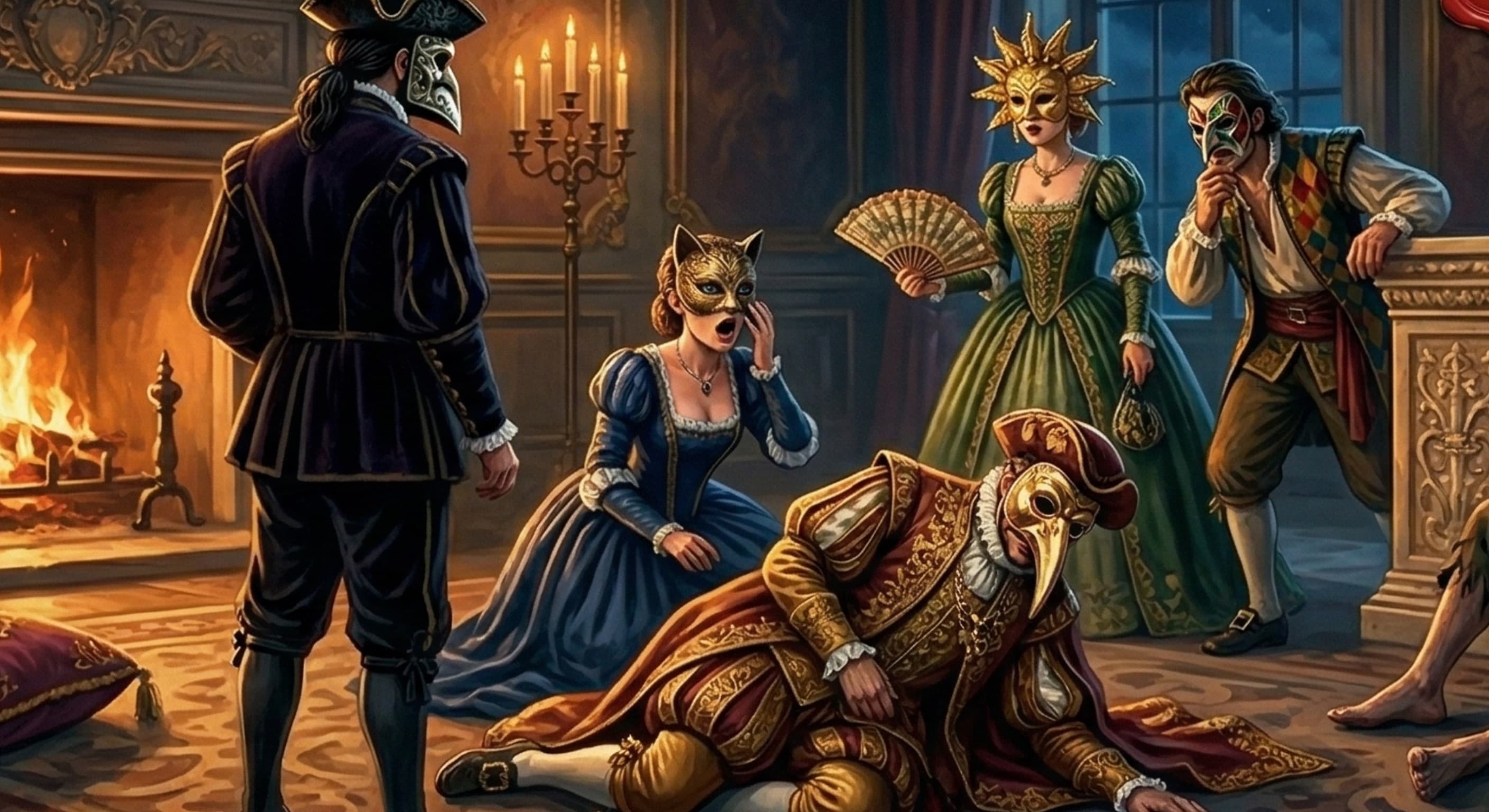
Venice, 1520. Carnival is at its peak, which means the whole city is legally entitled to be someone else for a few weeks. Inside a sumptuous palazzo, violins play, and after the great midnight toast the Doge collapses in front of his own court. He is dead by five past twelve. The masks are the whole design. Everyone in the room is already concealing a face, an allegiance and a name, so the usual social contract of a dinner party is suspended before the first clue is handed out. Beneath the costumes sit the real forces of the period: a Florentine merchant house with grievances against Venice, a papal envoy from Rome with instructions, a court physician who reaches a diagnosis remarkably quickly, and a household of advisors, artists and servants who each know one thing they were not supposed to hear. The poison of choice belongs to the era, and so do the compartment rings that half the court wears out of habit. It is theatrical, but the mystery underneath is tightly constructed.
The court you will be playing
Twelve roles fill the palazzo. Donna Isabella Grimaldi is the wife of the Doge and the highest ranking person left standing. Fra Benedetto is a monk and advisor who has the ear of the state. Captain Marco Venier is the Doge's bodyguard, which makes tonight either his failure or his opportunity. Lorenzo de' Pazzi is a Florentine merchant from a house Venice has good reason to distrust. Ambassador Rodrigo de la Vera arrives as a papal envoy from Rome with an agenda of his own. Dottore Baldassare Neri is the Doge's personal physician, Padua trained, who names the poison within minutes. Sofia Contarini is a Venetian courtesan who hears what men say when they think they are safe. Serafina da Mosto attends the Dogaressa. Maestro Guido Foscari composes and plays. Tommaso Vendramin runs the kitchens, which is to say he controls everything anybody drank. Madonna Lucrezia da Verona is a poet and court muse. Each sheet gives a biography, a motive, personal goals, conversations to start and reveal tiers.
How the evening unfolds
Plan two to two and a half hours of play plus half an hour of arrival and reading. The structure is the familiar one and it works: one sheet per player, ten minutes of silent reading, an opening passage read aloud, the collapse announced, and the first clues released immediately so that nobody is cleared too early. The middle act is open questioning driven by each player's own goals, with further clues released on the schedule in the host guide. The last act is deliberation, a secret ballot and the reveal. What is distinctive here is the masks. If your guests actually wear them, the first act plays differently from any other scenario, because players approach each other without knowing who they are addressing. Some hosts have guests unmask at the start of act two, which turns the reveal of identity into a beat of its own. That is optional and the kit works perfectly without it, but it is the best atmospheric trick in the catalog.
The right group for Venice
Six to twelve players, best around eight to ten. This is the scenario for a group that wants to look good and does not mind a little formality. It plays beautifully with people who enjoy hierarchy and etiquette as a game, because rank is genuinely load bearing here: what you may say to whom is part of the puzzle. It is also the easiest kit to sell to guests who claim they do not like role playing, since a mask gives a self conscious person somewhere to hide for the first twenty minutes. Because the aesthetic is romantic rather than grisly, it is the natural pick for an elegant celebration, an anniversary, or a wedding weekend event where you want the evening to feel designed, and the notes on /murder-mystery-wedding-party apply directly. It is also the scenario guests are most likely to photograph, which is worth something when you are putting real effort into a room.
What you need on the night
The kit is a PDF delivered in seconds and printed at home. Print one character sheet per player, the clue pages, the host guide and the solution on a sheet that stays out of sight. Masks are the one prop worth buying, and simple plain ones in black, white or gold are cheap and look better in a dim room than ornate novelty versions. Beyond that: candles everywhere you can place them safely, dark fabric over anything modern, gold or red accents, a mirror if you own one, glassware rather than plastic. Music should be early instrumental strings kept low. Dress can be as simple as dark clothing plus a mask and one flourish, a cloak, a sash, a jewel, a fan. Serve food that suits standing and talking: olives, cheese, figs, cured meat, small tarts. For drinks, one red and one sparkling option, with an equally good non alcoholic pour in the same glassware so nobody at a costume party is holding a soda can.
Who should choose a different kit
If your group is loud, restless and allergic to ceremony, Venice will feel like homework. The scenario rewards restraint and implication, and a table that wants to shout accusations across a room will get more from the casino or the island. It is also the wrong choice if nobody will dress up, because more than any other kit here, the atmosphere carries part of the mystery. Without masks it still works, but you lose the best thing about it. Do not pick it for children, and be careful with a group of very literal minded players who want physical evidence to handle, since the material here is conversational and political rather than forensic. Those players will be much happier with the document based investigations on /detective-case-files. Finally, if half your guests will arrive separately over an hour, choose something else. This evening has a formal opening and it suffers when people trickle in after the toast.
Small choices that raise the whole evening
Greet guests in character at the door and hand them their mask before their character sheet. It takes ten seconds and changes how they enter the room. Address everyone by title, not by name, for the first act: Ambassador, Captain, Maestro, Donna. It sounds artificial for about four minutes and then the table adopts it entirely. Keep the lighting genuinely low and use real candles wherever it is safe, since the whole look depends on it. Release the clues on the schedule instead of early, because the first ones are meant to scatter suspicion across the court and the later ones to narrow it. Give the loudest guest a role with standing, since rank gives a big personality somewhere legitimate to put itself. And when you read the solution, read all of it, including why each of the other courtiers is cleared. On a scenario about masks, the unmasking is the entire payoff.
Frequently asked questions
How many players does The Masked Ball take?+
Six to twelve, with eight to ten as the sweet spot. The PDF is trimmed to the group size you pick at checkout, so there are never spare roles. A court naturally holds nobles, clergy, servants and visitors, so the cast stays believable across the whole range.
How long is the evening?+
Two to two and a half hours of play, plus about thirty minutes for arrival, sheets and reading. The host guide gives act timings and clue release points, so you can keep the pace without improvising anything on the night.
Do we actually need masks?+
The kit works without them, but masks are what makes this scenario special. Plain black, white or gold ones are inexpensive and look better in candlelight than elaborate novelty versions. Many hosts have everyone unmask at the start of the second act, which creates a memorable beat.
What do I receive and what does it cost?+
A print ready PDF from $39, delivered in seconds with nothing shipped. It includes the full host guide with act timings, one character sheet per player with motive, goals and reveal tiers, the clues to hand out during the evening, and the complete solution printed separately for the host.