What changes when you remove civilization
Most murder mystery settings assume that rules still exist. Somebody will call the police eventually, a reputation is worth protecting, and there is a tomorrow in which consequences arrive. A desert island removes all three, and that changes the conversation at your table completely. Players stop asking who had an alibi and start asking who benefits from one fewer mouth to feed. Motives become physical: water, medicine, a signal flare, a place in a boat that seats four. Those are easy for guests to understand and impossible to argue away, which makes the accusation round unusually intense. The theme also equalizes the group. There are no costumes signaling wealth and no expertise to hide behind, so quiet guests are not outranked by loud ones. That equality makes the island a strong choice for groups where people do not know each other well, including colleagues, which is why versions of this setting appear so often in the scenarios recommended on /murder-mystery-team-building.
The easiest costume brief you will ever send
Tell guests to come dressed for the crossing they were on, then ruin it slightly. That means the clothes they would wear on a boat, a cruise, or a small charter plane, with sleeves rolled, shirts untucked, hair loose, and shoes optional. Linen, pale colors, and stripes read as maritime without any effort. A blazer worn over a creased shirt suggests someone who boarded looking expensive and has been sleeping on sand for three days. Some guests enjoy the small theatrical touches: a torn hem, a bandage on one arm, sunburn drawn on with blush, salt stiff hair made with a little sea spray. Others will simply arrive in shorts, and that is completely fine. Uniformed roles are useful for contrast, so give one character a ship officer's shirt and another a flight suit or coveralls. The point of the brief is that nobody has to buy anything, which makes this the cheapest theme to dress of the ones covered here.
Building a beach indoors, cheaply
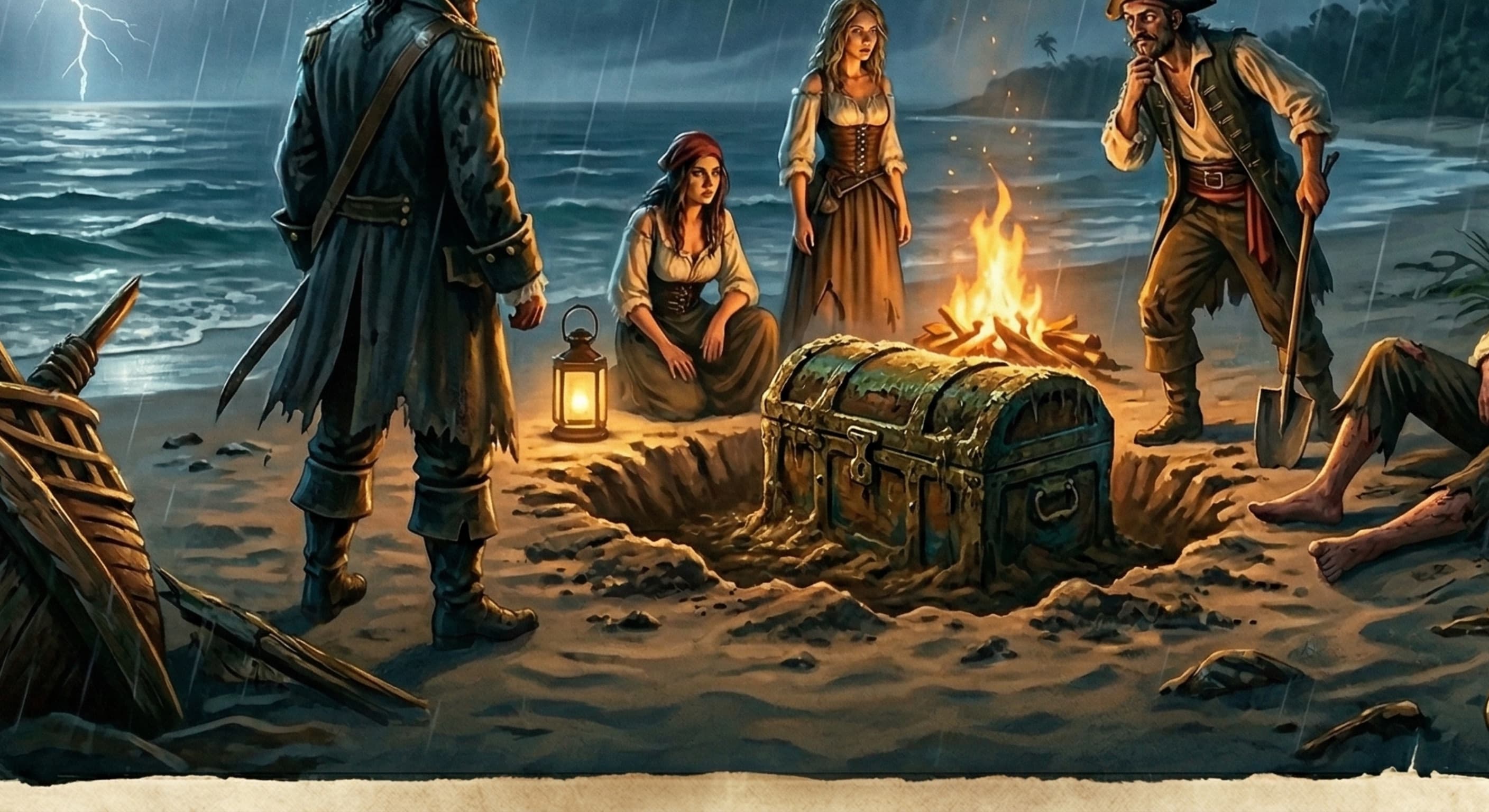
The three things you need are firelight, texture, and salvage. Firelight comes from candles clustered low on the floor or a fake fire made from battery lights under crumpled paper, and it should be your only light source once the game starts. Texture comes from a large sheet or drop cloth on the floor, cushions instead of chairs, and anything rough: rope, burlap, a fishing net if you can borrow one, palm leaves or any large houseplant moved into the room. Salvage is where the theme comes alive. A cracked crate, a battered suitcase, a life ring, a broken oar, a lantern, empty bottles, a first aid tin with almost nothing left in it. Arrange them as if they washed up rather than as a display. Get guests off chairs and onto the floor, because sitting in a circle on cushions in firelight changes how people talk far more than any decoration. Keep one bright lamp nearby so players can still read their documents.
Sound: water, wind, and no music at all
This is the one theme where a playlist can actively hurt you. A castaway night works best with an ambient loop only: waves, wind, distant gulls, and insects at night. Music implies civilization, and the absence of it is exactly the feeling you want. Keep the loop low and continuous so that guests forget it is playing, then use silence as your effect. Cutting the sound for a few seconds before an announcement makes the whole room turn around. For round markers, use something from the world rather than a bell: a conch, a whistle, or someone shouting that a sail has been spotted on the horizon. If you are hosting outdoors, you may need nothing at all, since a real garden at night with a real fire already sounds right. Test any ambient track for length before the party, since short loops with an obvious seam become distracting once guests have heard the same wave twice.
Plots that run on scarcity
The best island scenarios put a countdown in front of the players. Water runs out in four days. The signal fire can only be lit once, because there is one flare. The boat that arrives will take four people and there are nine of you. Every one of those creates an argument that continues under the murder investigation and makes the accusation genuinely consequential. Layer a secret from before the wreck underneath, because strangers thrown together is less interesting than a group that already contained a grudge. Someone owned the boat. Someone was chartered to take a passenger somewhere quietly. Someone recognized another survivor from a trial. Use physical clues that could plausibly survive salt water: a page from a logbook, a tin with initials, a knife, a wet photograph. Avoid anything that requires electricity. The castaway titles available on /murder-mystery-kits are structured this way, with the resources themselves acting as the clock that drives the evening forward.
The trap this theme falls into
The trap is comedy. A castaway setting is one costume away from a beach party, and once one guest starts playing it for laughs the tension never comes back. Set the tone in the invitation and again in the opening passage: this is three days after the wreck, people are hurt, and the water is nearly gone. The second problem is overreliance on physical challenges. Building a shelter or racing to start a fire sounds fun and reliably eats twenty minutes of investigation time without adding information. If you want an activity, make it produce a clue. The third is stranding without history, which leaves players with nothing to discuss except the present, and the present is thin. Every character needs a past connection to at least two others. The fourth is forgetting comfort, because a floor and cushions are wonderful for forty minutes and painful for three hours. Offer real seating at the edges of the room, and make sure the food is easy to eat with your hands.
Frequently asked questions
Does this theme need to be hosted outdoors?+
No. A living room with the furniture pushed back, cushions on the floor, and candlelight works extremely well, and you keep control of sound and weather. If you do host outdoors, plan for lighting after dark and have a rain alternative, since documents and wind are a poor combination.
What food suits a shipwreck murder mystery party?+
Serve food that supports the story: fruit, nuts, bread, grilled fish or skewers, and water in bottles. Handing out small rationed portions at round changes is a memorable touch that reinforces scarcity. Keep everything edible without cutlery, since plates get in the way of movement.
Can this work for a group that does not know each other?+
Yes, it is one of the best options for that situation. Nobody needs prior knowledge, there is no dress code hierarchy, and the survival premise gives strangers an immediate shared goal. That is exactly why the setting works so well for colleagues and mixed groups.
How dark should the tone be?+
Dark enough that decisions matter, but stop short of genuine cruelty. Scarcity, fear, and a countdown create tension without anyone feeling attacked. Tell your group in advance what tone to expect, and keep the reveal focused on the killer's motive rather than lingering on the violence.