A heat wave, a studio lot, and a picture that has to finish
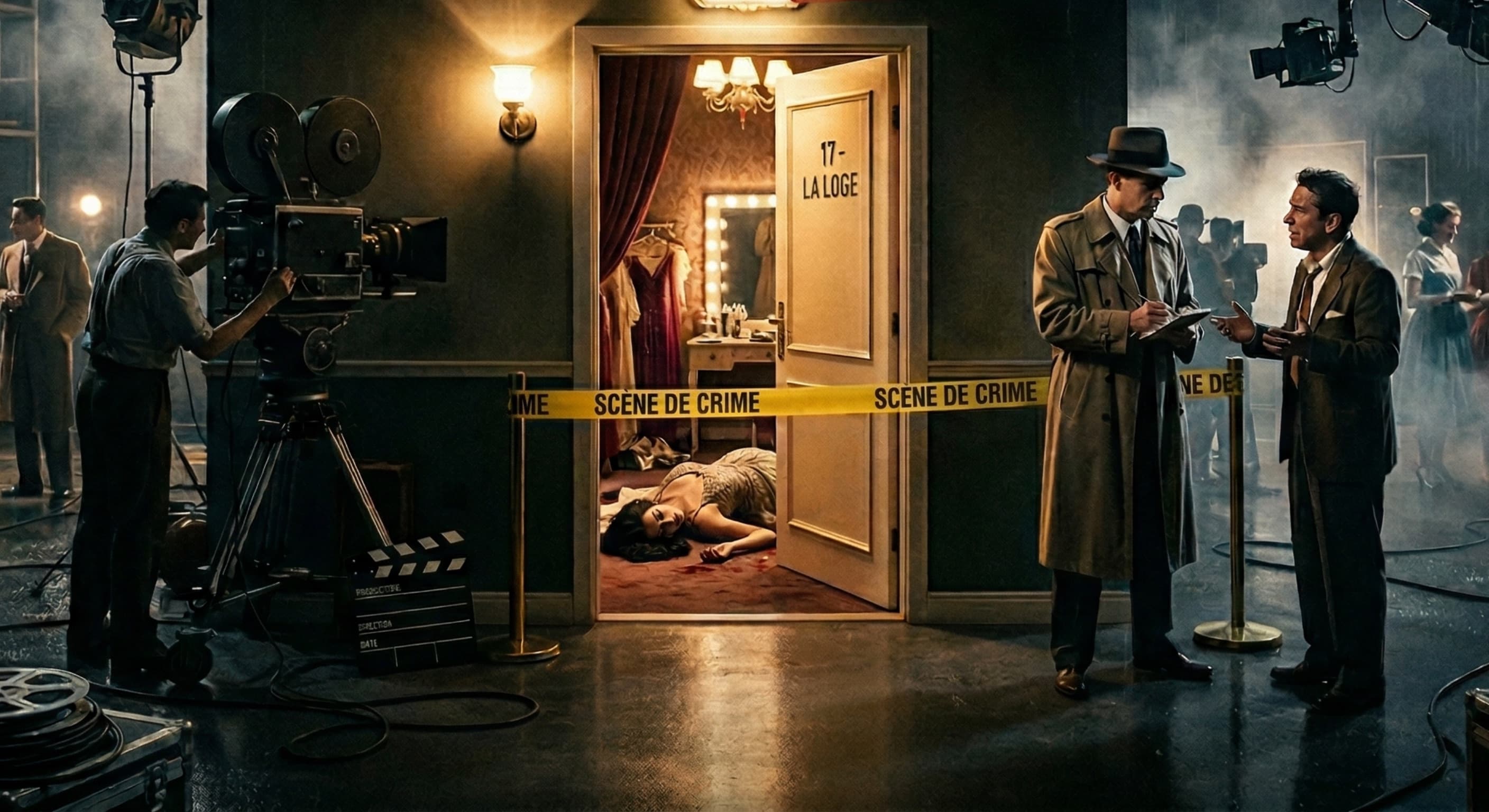
The Meridian Pictures lot is shooting the last scenes of a noir thriller the whole town expects to sweep the Oscars. At first light, the assistant director knocks on the star's dressing room door and gets no answer. Gloria Swann, fifteen years at the top, is found slumped in her makeup chair with her screen foundation still on. The coroner offers a vague verdict. A closer look at the makeup says otherwise. What makes this scenario unusual is that the crime is not a single moment of passion. It is slow, methodical and planned, and the investigation therefore reaches back across weeks of dated evenings rather than one night. The world around the victim is a whole industry: a director, a producer, an agent, makeup and wardrobe, a screenwriter, a co-star, a rival, a columnist and the studio front office. Everybody in that world needed something from her, and several of them needed her out of the way. The atmosphere is glamour with rot underneath, which is exactly what film noir is.
The people on the lot
Twelve roles orbit the dead star, and they are drawn as working people rather than caricatures. Rex Howard is the veteran director on his third picture with Gloria, a perfectionist whose schedule and budget she was quietly destroying. Sam Weston is the producer, and producers always have a file somewhere. Dorothy Lane has done Gloria's makeup for twelve years, absorbed twelve years of public humiliation, and knows everything that happens in the dressing room corridor, which makes her the key witness of the evening. Irene Dupont runs wardrobe, with racks that sit right next to the makeup drawers. Eleanor Mansfield writes the column that can end a career in four hundred words. Tony Marcello is the co-star. Jimmy Crane and Barbara Cole work in archives and production. Walter Gaines brings the technical eye. Each character sheet carries an age, a background, a motive, three personal goals, conversations to start, and reveal tiers that tell the player what to admit freely, what to give up under pressure, and what to deny unless the evidence is overwhelming.
Three acts and seven clues
This kit runs in three clearly timed acts. Act one takes thirty to forty five minutes: sheets are handed out, ten minutes of silent reading, the opening is read aloud, and the first two clues establish the method and one dated night, which immediately puts every name on the watchman's log in play. Act two runs sixty to ninety minutes of open questioning, with further clues released at fifteen, thirty five and fifty five minutes so that suspicion keeps reorganizing itself. One scripted plot twist lands mid act and reopens the whole board. Act three is thirty to forty five minutes: a seventh clue is held back as a wild card for a stuck group, then fifteen minutes of deliberation, a secret ballot, and the reveal. The host guide even supplies an optional late escalation for tables that are enjoying themselves. Three and a half hours sounds long on paper. In practice the acts are so clearly signposted that the evening runs itself.
Who this one is for
Six to twelve players, rated intermediate, and the only kit in the catalog that comfortably fills an entire evening. Choose it when your group has done at least one murder mystery party before and complained that it ended too soon. It rewards players who enjoy performance: the roles are theatrical by construction, and a guest who wants to chew the scenery finally has somewhere to do it. It is also the most photogenic scenario in the range, which matters more than hosts admit. A 1950s dress code is easy and flattering, the pictures are excellent, and the theme lands well for a glamorous milestone celebration or a bachelorette weekend, where the notes on /murder-mystery-bachelorette-party apply almost unchanged. For a group that wants a shorter, gentler first outing, pick a two hour scenario from /murder-mystery-kits and come back to this one. Nothing is lost by waiting, and the extra length lands far better on a table that already knows how these evenings work.
Preparing the set
Everything arrives as a PDF in seconds and you print it yourself. Print one character sheet per player, the seven clue pages in order, your host guide, and the solution on its own sheet kept somewhere guests will never see it. Because there are more clues here than in the shorter kits, sort them into a numbered stack before anyone arrives and keep them face down. For the room, think studio rather than mansion: a couple of directional lamps, a chair with a mirror and a towel over the back as a dressing table, a clapperboard if you can improvise one, a stack of scripts, a bowl of ice for the heat wave. Dress code is 1950s Hollywood, which for most guests means a dark suit or a good dress plus a hat, sunglasses or red lipstick. Serve a long evening's worth of food in two waves rather than one, because three and a half hours is a real dinner. Keep drinks at one station so the room keeps circulating.
Who should choose something else
Do not pick this as a first murder mystery party for a group that has never played. It is longer, the cast is larger, and the timeline reaches across several dated nights, which is one demand too many for beginners. Start with a two hour kit and graduate to this one. It is also wrong for an evening with a hard stop. If people must leave at ten, a three and a half hour scenario will be cut off mid deliberation, which is the worst possible ending. Do not run it with children or young teenagers: the material is adult, the reading is heavy, and there is real content about exploitation inside an industry. And skip it if your guests will not commit to staying in character for the duration, because the length that makes it great with an engaged table makes it punishing with a distracted one. If you want a shorter analytical evening for two to six people instead, the printable detective case files run ninety minutes to two hours.
Running it well
Use character names throughout and give the supporting cast a voice yourself, because the kit names a few offstage figures the players will ask about. Announce the act boundaries out loud. The single most common hosting mistake on this scenario is releasing clues early because the room feels quiet, which collapses ninety minutes of investigation into thirty. Trust the schedule. Remind players at the start of each act that their sheet carries three drivers, namely personal goals, conversations to start, and reveal tiers, since that is what stops people from becoming spectators. If someone goes quiet, whisper one of their own opening conversations to them rather than putting them on the spot. Save the wild card clue for a genuine stall. And close the night with two small awards, one for the sharpest deduction and one for the best performance, which on this scenario is the award everybody actually wants.
Frequently asked questions
How long does Hollywood Noir really take?+
Two and a half to three and a half hours of play, plus arrival and reading time. It is the longest kit in the catalog. Plan a four hour window from doorbell to reveal and do not schedule it on a night when guests have to leave early, because the deliberation is the payoff.
How many players and what difficulty?+
Six to twelve players at an intermediate level. The PDF is trimmed to the group size you select at checkout. Intermediate here means a larger cast, a timeline that covers several dated nights, and more clues to track, not that anyone needs prior experience with role playing.
Is it a good first murder mystery party?+
Honestly, no. It is excellent as a second or third. For a group that has never played, a two hour scenario is a better introduction, and everyone will be ready for the extra length afterward. Hosts who start here often report that the middle act felt long to first timers.
What is in the download and what does it cost?+
A print ready PDF from $39, in your inbox within seconds and nothing shipped. You get the complete host guide with three timed acts, one character sheet per player with motive, goals and reveal tiers, seven clues to release on schedule, and the full solution printed separately for the host.