Anonymity is a game mechanic, not just decoration
Most themes decorate the story. The masquerade changes how the story can be told. Once faces are covered, the sentence I saw him in the east corridor becomes unreliable, and unreliable testimony is the most valuable resource a mystery can have. Two characters in similar costumes can be confused for each other. A servant can enter a room full of aristocrats without being recognized. Someone can be somewhere they were forbidden to go. Build at least one of those into the evening and the investigation has an entire extra layer that no other theme provides for free. Anonymity also helps your guests. Shy players consistently report that a mask makes it easier to speak in character, because the part of them that fears being watched is partly hidden. For a group that has never done this before, or a group where several people are nervous, a masquerade is genuinely a kinder format than a theme requiring everyone to be recognizably themselves all evening.
Masks: what to ask for and what to supply
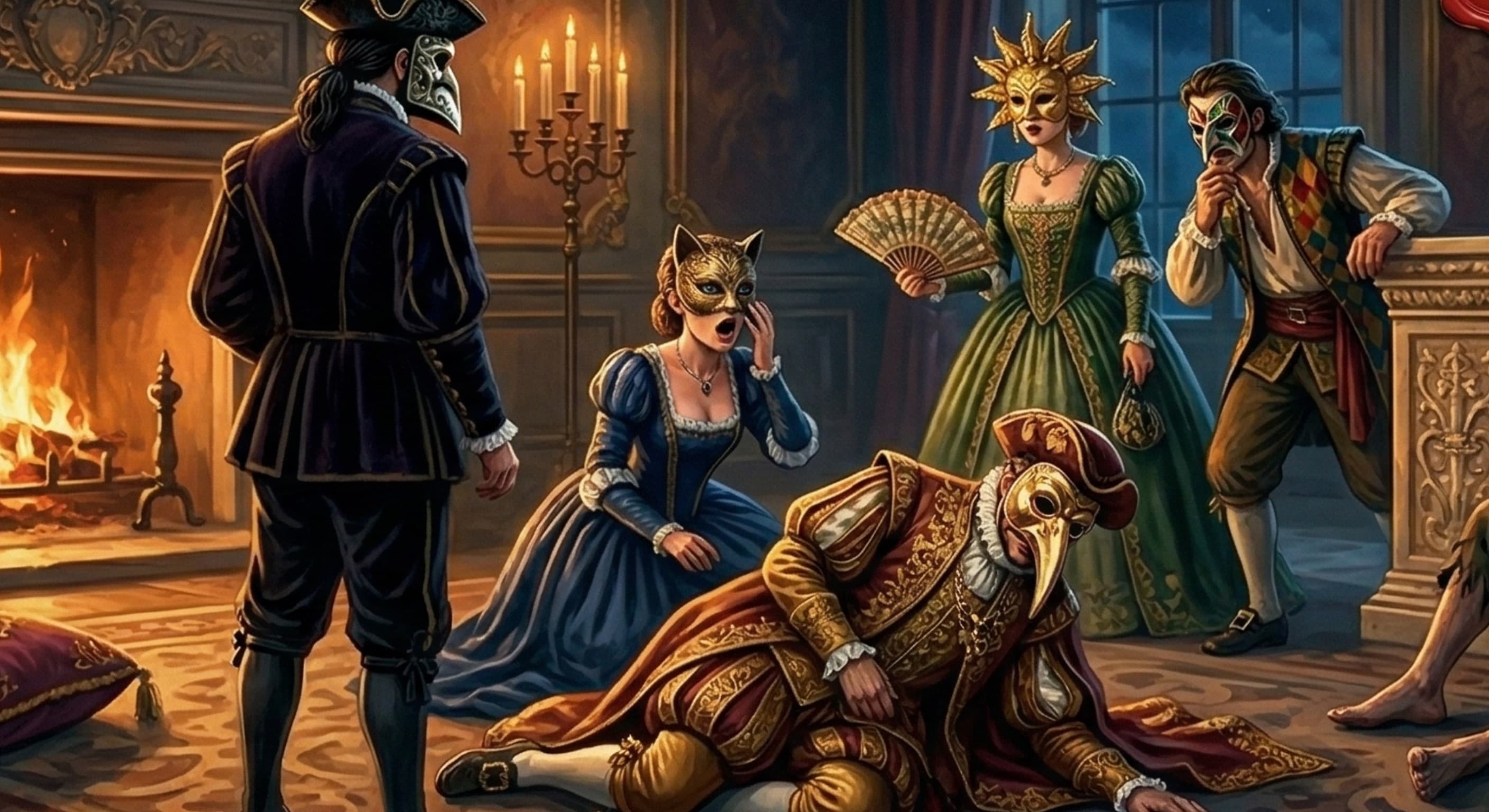
Ask guests to bring a mask, then buy a box of plain ones yourself for the people who forget, which will always be at least two. Simple eye masks are the practical choice because they leave the mouth free, and anything covering the mouth will be removed within the first hour when people cannot be heard or eat. Venetian style masks on a stick are excellent, since guests can raise and lower them, which creates natural dramatic moments and solves the comfort problem entirely. Plain masks plus feathers, ribbon, and paint make a good pre party activity if your group enjoys that. For the plot, consider assigning mask colors or motifs to factions so that players can identify groups without identifying individuals, which sharpens the misdirection. Decide and announce one rule at the start: whether masks come off at a set moment, usually midnight or the accusation, and enforce it, because that moment lands beautifully when the whole room does it together.
Costume guidance that does not scare anyone off
The instinct is to demand full period dress, and that instinct loses guests. Set the bar at dark or jewel colored formal clothing plus a mask, and describe anything beyond that as optional. Under that rule, a suit works, a cocktail dress works, and a long gown works. Guests who want to go further can add a cape, gloves, a tailcoat, a corset top, or a hair ornament, and they will look spectacular next to the simpler outfits rather than embarrassing them. Choose a palette and put it in the invitation, because a ball where everyone is in black, wine, and gold looks deliberate, while a ball in every color looks like a costume shop. If your scenario assigns houses or factions, give each one a color. Keep one box of spare masks, a couple of capes, and some ribbon by the door so latecomers can be brought into the picture in under a minute. That box rescues more evenings than any other host purchase.
Light, music, and the shape of the room
Candlelight is the entire look. Use as many small light sources as you can manage and no overhead lighting at all, with mirrors placed to double whatever you have. Silver and gold surfaces catch candlelight and sell the room instantly. The most useful decorating decision is spatial rather than visual: clear the center of the room and push seating to the edges. A ball needs people to circulate, and a room full of chairs produces a dinner party with masks on. For music, baroque or classical strings at low volume work for a period ball, and a waltz played once at a marked moment gives you a scene everyone remembers. If your setting is more modern or gothic, instrumental music with a pulse works as long as it never becomes loud enough to prevent conversation, which is the fastest way to kill an investigation. Keep one well lit table at the side where players can actually read the clue documents they are handed.
Plots that use the mask
Three structures pay off here. The first is the substitution, where two characters swapped masks at some point in the evening, which invalidates half the testimony the players have collected. The second is the intruder, where someone present is not on the guest list at all and is only discoverable through inconsistencies in what they know. The third is the letter, where an anonymous invitation brought several people to the same house for reasons none of them will admit. Layer in a host who assembled the guest list deliberately and you have a night where the party itself is the crime scene. Practical clues include a dropped mask, a torn invitation, a dance card with a name that should not appear on it, and a servant who can describe shoes but not faces. Ready to print scenarios built around masks and mistaken identity are on /murder-mystery-kits, and every one of them downloads as a PDF you print at home.
Practical problems masks create
Masks are wonderful and mildly inconvenient, and a prepared host solves the inconvenience in advance. Guests cannot recognize each other, which is charming for twenty minutes and frustrating by round two, so give every character a name card, a sash, a colored ribbon, or a distinctive accessory that identifies the character even when the face does not. Masks slip, fog glasses, and make eating awkward, so state clearly that masks may be lifted to eat and drink and set a table where people can do that. Reading small print through an eye mask is harder than it sounds, so print character sheets a size larger than usual. Watch for guests quietly withdrawing behind a mask rather than being freed by one, and check on anyone who has gone silent. Finally, never let the killer be identifiable by costume alone, because a room that can solve the case by looking at shoes will do exactly that and be finished before dessert.
Frequently asked questions
Where do I get masks without spending much?+
Plain eye masks are available in packs online and at party stores for a couple of dollars each, and decorating them with ribbon or paint is a good pre party activity. Ask guests to bring their own and keep a box of spares by the door for the people who forget.
When should guests take their masks off?+
Pick a single dramatic moment and announce it at the start, usually midnight or just before the accusations. Everyone unmasking at once is one of the best scenes this theme offers, and holding it until the end keeps the anonymity working for the whole investigation.
Is a masquerade good for a bachelorette party?+
It is one of the strongest choices, because the dress code is glamorous, the photographs are excellent, and masks help a group that does not all know each other relax quickly. Guidance for that format is on our bachelorette page at /murder-mystery-bachelorette-party.
What era should a masquerade ball be set in?+
Eighteenth century Venice and late nineteenth century Europe are the classics, and both are forgiving because guests interpret them loosely. A modern or timeless gothic ball also works and is easier to dress. Whatever you choose, name it in the invitation so the room looks coherent.