What each evening actually is
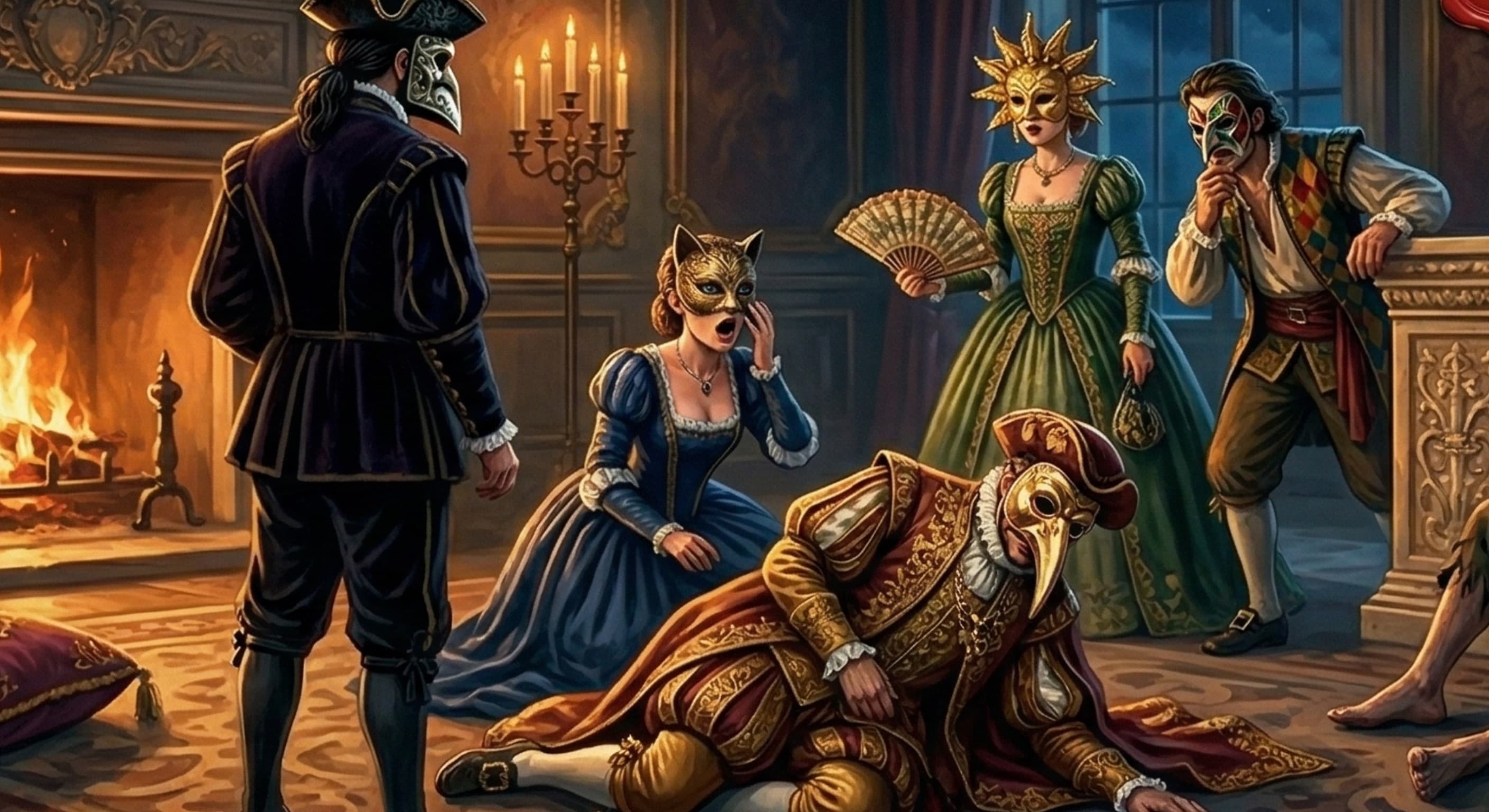
A board game night is a sequence of games with rules. Someone teaches, everyone plays by turns, the game produces a winner, and then the group either plays again or switches to something else. The structure is external: the board and the rulebook decide what happens, and the players optimize inside that structure. A murder mystery party is a single continuous scenario. Each guest receives a character with a history, a motive and a few secrets, a crime is announced, and for the next two or three hours the group talks its way toward a solution. There are almost no rules to learn. What replaces them is a script of information: each sheet tells its player what to reveal and roughly when. One evening rewards reading a rulebook well. The other rewards listening to people well. That difference explains most of what follows, including why some groups adore one format and find the other faintly exhausting.
What a board game night genuinely does better
It is far easier to organize. You already own the games, there is nothing to buy, print or assign, and you can decide to have one an hour before it starts. Nobody needs to read anything in advance or commit to a character. It is also easier to leave. Games end in forty minutes, so a guest who has to go at nine causes no damage at all, whereas leaving a mystery midway pulls a thread out of the plot. Board games scale down gracefully: three people who showed up can still play something good, while a murder mystery party written for eight cannot be run with three. And they repeat. A game bought once is played for a decade, and the cost per evening drops toward zero. Most importantly, a board game night makes no social demand. Nobody has to perform, adopt a voice, or claim to be a jealous cousin. For groups where that prospect causes genuine dread, the board game is the right call and it is not a compromise.
Where a murder mystery party pulls ahead
It removes the rules barrier entirely, which matters more than experienced gamers usually realize. A heavy strategy game punishes the newcomer for forty minutes before they understand what they are doing, and the person who has played it twelve times wins. In a murder mystery party nobody has an advantage, because the only skill is asking questions and paying attention. That makes it far better for a mixed group: partners who do not play games, colleagues, relatives, a friend of a friend. It also produces stronger memories. People remember the moment someone unexpectedly confessed at the table years after they have forgotten who won at anything. And it suits an occasion. A birthday, an anniversary or a bachelorette weekend calls for an evening with a shape and an ending, which is exactly what a scenario provides and a stack of boxes does not. Kits on /murder-mystery-kits are built for that single-evening arc rather than for repeat play.
The experience gap, in both directions
Board game nights have a well-known problem: the enthusiast. One person owns the collection, teaches the rules, knows the strategy, and wins comfortably while insisting the game is really quite simple. Newcomers end up playing a tutorial in which they lose. Good hosts manage this by choosing lighter games when the group is mixed, which works but narrows the shelf considerably. Murder mystery parties have the opposite imbalance. There is no rules advantage at all, but there is a comfort advantage: the guest who enjoys performing will fill more airtime than the guest who does not. Well-written scenarios counter this by giving every character specific facts that other players need, so a quiet guest still gets approached repeatedly. Neither format is neutral, then. A board game night rewards whoever has played the most. A murder mystery party rewards whoever is most at ease talking. Choose based on which imbalance your particular group handles better.
Prep and hosting load compared
Board game night preparation is roughly fifteen minutes: clear a table, pull three boxes, buy snacks. The hosting load during the evening is teaching rules, which is real work but familiar work. A murder mystery party takes about two hours of preparation spread across a week. Buying and downloading takes five minutes. Printing takes thirty, including sorting sheets into envelopes. Reading the host guide takes twenty, and it should be done properly rather than skimmed. Assigning characters and sending them out takes another twenty. On the night itself the host reads a few short passages aloud and distributes clues between rounds, which is lighter than teaching a complicated game. So the load is front-loaded rather than larger. If you are the kind of host who likes a plan finished before guests arrive, that shape suits you. If you prefer improvising on the day, board games fit your temperament better and there is no point pretending otherwise.
Cost, reuse and the honest math
A board game costs thirty to sixty dollars and is played dozens of times, so the cost per evening approaches nothing. A printable mystery kit costs thirty-nine to fifty-nine dollars for the whole group, and with a given set of friends it is realistically played once, because the solution cannot be unlearned. That is a genuine point in favor of board games and it should not be waved away. The counterweight is that you keep the files permanently and can run the same scenario with a different group later, which many hosts do a year or two afterward. Cost per person for one evening also lands low: a party of ten works out at three or four dollars a head, less than a single round of drinks. The useful conclusion is not that one is cheaper. It is that a board game is an investment in many ordinary evenings, and a mystery kit is a purchase for one specific evening that needs to feel different from the others.
How the two fit together across a year
Most groups do not have to choose permanently. The pattern that works is monthly board game nights, which are low effort and easy to schedule, plus one or two murder mystery parties a year attached to occasions that deserve more structure. A birthday is the obvious anchor, and there is a full planning guide on /murder-mystery-birthday-party for that case. New Year, Halloween and a summer gathering with people who rarely see each other are the other natural slots. Using the mystery format sparingly protects what makes it work: the novelty, the effort visible in the printed materials, and the fact that guests clear a whole evening for it. Running one every month would flatten it into just another game night, which is precisely what it is not. A year with ten easy game nights and two mysteries in it feels varied. A year with twelve of either starts to feel like a routine. Think of board games as your regular rhythm and murder mystery parties as punctuation.
Frequently asked questions
Is a murder mystery party a board game?+
No. There is no board, no turns and almost no rules. Players receive character sheets with private information and spend the evening in conversation. The closest board game relatives are social deduction titles, but even those are games with win conditions, while a mystery scenario is a story with a solution.
Can you play a printable murder mystery kit more than once?+
Not with the same players, since the culprit is known from that point on. You keep the PDF files permanently, so many hosts run the same scenario a year later with a different group. If you want repeat play with one group, a board game is the better purchase and a kit is the better occasion.
Which works better for people who do not know each other well?+
A murder mystery party, usually. Characters give strangers a reason to approach one another and something specific to talk about, which removes the hardest part of meeting new people. Board games can work too, but they encourage everyone to stare at the table rather than at each other.
What if half the group loves heavy strategy games?+
That half will enjoy a mystery too, because the deduction is real, but they should not expect optimization to help them. Tell them in advance that the win comes from what people say rather than from mechanics. Running a shorter game first and the mystery second keeps both camps happy.