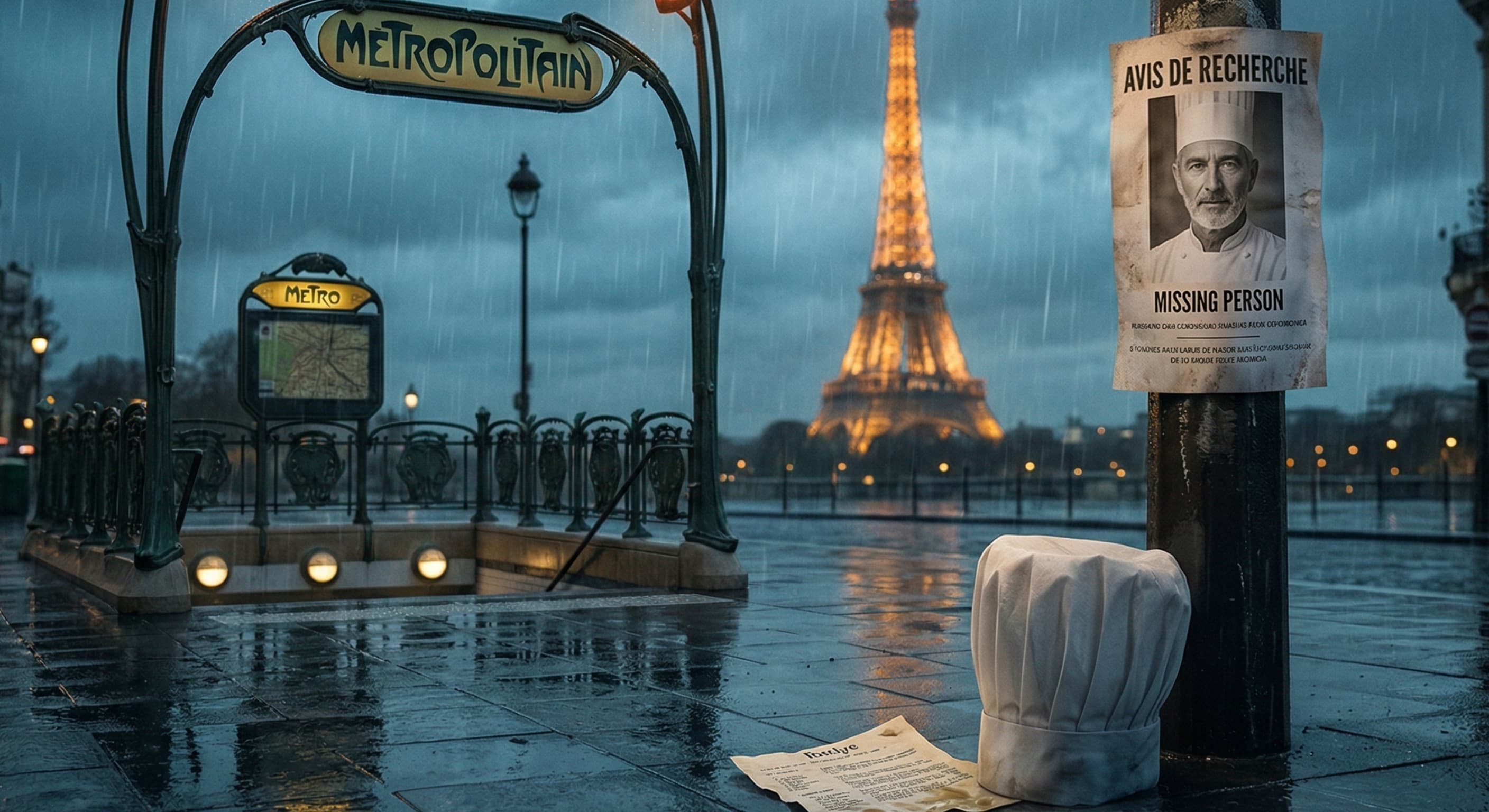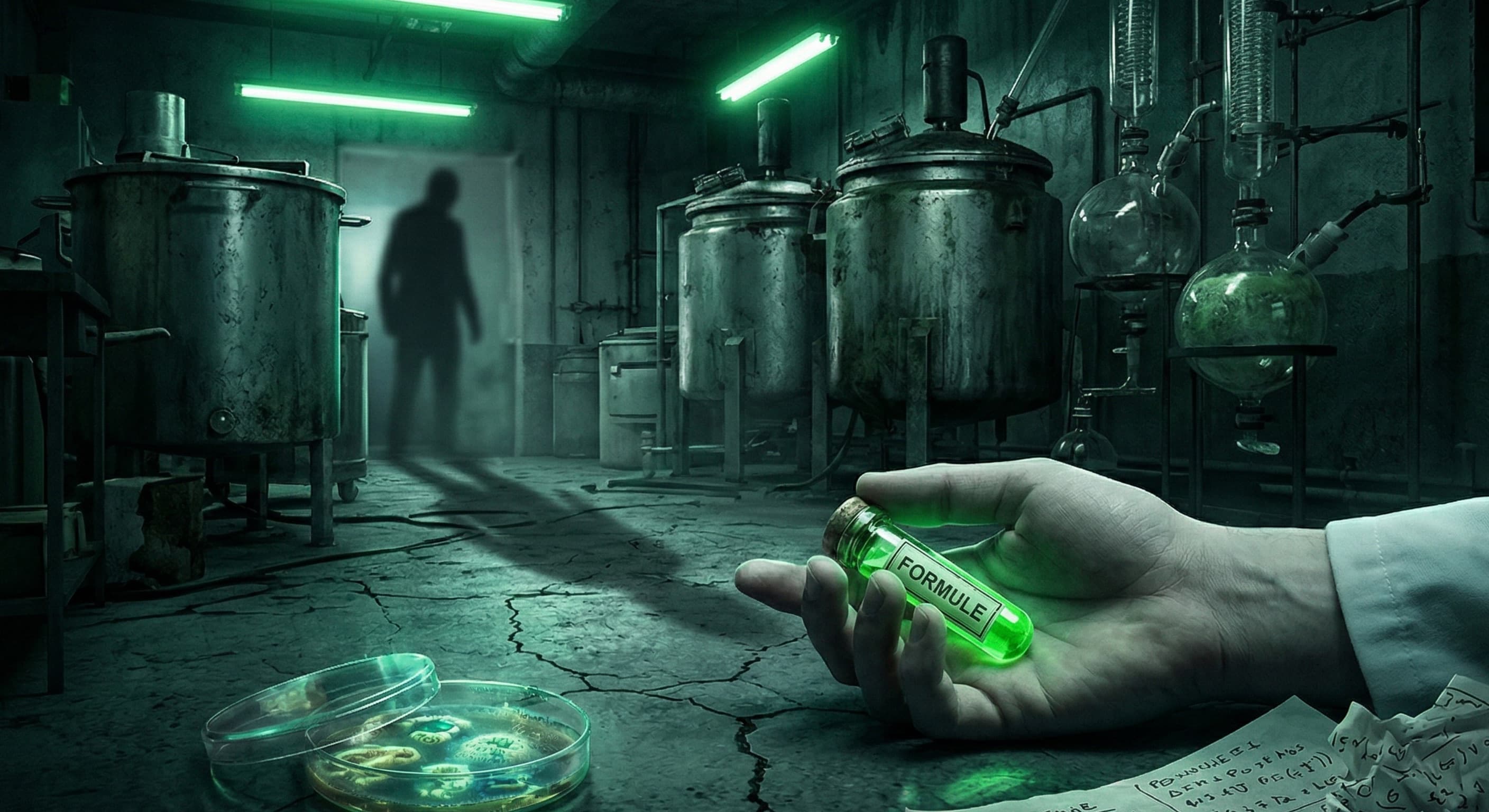
A sealed room under a house in Lyon
Dr. Viktor Stein, fifty seven, a geneticist of international reputation, is found dead in an underground laboratory built beneath his property on rue Pasteur in Lyon. His assistant raises the alarm at a quarter past seven in the morning. The laboratory was locked from the inside with a six digit access code, and the early findings point to a lethal injection of an unknown compound. Stein had been dismissed from a major institute in 2019 over experiments judged unethical, and had carried on his work in private, funded by investors, in a facility reachable only by an elevator hidden behind a bookcase. For three years he had been working on a classified project, a gene editing serum, and the paper that would have revealed it to the world was days away from publication. The laboratory itself is divided into four zones, a main lab, a cold room, a private office and an injection room, and knowing which zone a person could reach, and when, turns out to matter a great deal.
Five suspects and ten exhibits
The file names its suspects openly, which is unusual and deliberate. There is the research assistant who had worked beside Stein since 2021 and who found the body. There is a former colleague from the institute, now an occasional consultant. There is a representative of the pharmaceutical company funding the work, who had a heated argument with Stein about intellectual property two days before his death. There is Stein's twenty eight year old son, a biochemistry student. And there is his former doctoral advisor, still in touch with him after decades. Around them sit ten exhibits: an autopsy report, the assistant's witness statement, a coded message from Stein's own notebook, a toxicology report on the compound, the final entries in his lab notebook, recovered emails, a local newspaper article, the floor plan of the underground facility, the investor's buyout contract, and the access log for the night in question. Five puzzles run alongside, with progressive hints and a sealed solution at the back.
Elimination, not accusation
This file teaches a stricter method than the others in the range and it is the main reason to buy it. A suspect is guilty only if motive, means and opportunity are all present at once, and if any one of those three collapses the suspect is cleared. Motive means a serious reason to want Stein dead. Means means the technical knowledge to synthesize and inject the compound. Opportunity means being physically inside the injection room during the window of death, which the file fixes between nine and eleven in the evening. The guide warns you twice about the obvious trap: a spectacular motive is worth nothing without opportunity, and being on site during the day proves nothing if the visit falls outside the window. It also asks you to separate the person who ordered a crime from the person who carried it out, which is a distinction most case files never bother with. One practical detail: the French paperwork runs on a twenty four hour clock, so a report saying 21:00 means nine in the evening.
How an evening actually plays
Nobody hosts and nobody plays a character. You read the briefing together and write down the window of death, because almost everything hangs on it. Then you work through the ten exhibits, noting motive, means and opportunity for each of the five suspects as you go. You solve the five puzzles by cross referencing documents, including the coded message Stein left in his own notebook and the access log that records who went where. Then comes the elimination round, where you strike suspects off one at a time as each one fails a test, and finally the deliberation, where you present the single name that survives together with the reason none of the others can be it. Only then do you open the solution. Two hours is realistic for a table of four. The file states plainly that no document names the culprit: the name is deduced by crossing the window of death, the access log, and the alibi that contradicts itself.
The table this is for
Two to six players, rated four stars out of five. It suits people who like systems. If your group enjoys logic grids, spreadsheets, or the satisfaction of ruling things out, this is the file in the catalog built for that pleasure, more so even than the wartime one. It plays very well for two, because the elimination work divides naturally between a reader and a note taker, and it is excellent for four, where you can assign two suspects each and then argue. The contemporary setting also makes it the most accessible file for players who bounce off historical material: there is no period vocabulary to absorb and the forensic language is the one everyone already knows from television. Science students and people who work with data tend to love it. If you want the same rigor written around your own group and your own setting, the bespoke service on /custom-murder-mystery does exactly that.
Who should choose something else
This is not a first case file. Four stars means the method matters as much as the evidence, and a table that has never done one will spend the first half hour learning how to read the documents rather than solving anything. Start with a three star file on /detective-case-files and come back to this. It is also wrong for anyone who wanted a party. There are no characters, no costumes and no performance, and a group that came to act will be disappointed within ten minutes. Skip it for children: the content includes unethical human experimentation, a detailed autopsy report and toxicology, and the reading level is adult throughout. Anyone squeamish about clinical detail should look at the Victorian or the museum files instead, which cover similar ground without the medical specifics. And do not attempt it in a noisy room with a half table, because the access log work needs concentration and a flat surface.
Getting it right on the night
Print everything, cut out the evidence, and give yourself a big clear table. Write the window of death on a sheet of paper and keep it visible all evening, because at least one confident wrong theory in every session dies the moment somebody points at that sheet. Make a simple grid with the five suspects down one side and motive, means and opportunity across the top, and fill it in as you read rather than at the end. Convert every twenty four hour time into the format your group thinks in, immediately, in writing. Take the progressive hints one at a time with real discussion between them. Before you open the sealed solution, write your full conclusion: how it was done, who did it, and one sentence for each of the other four explaining exactly which of the three conditions fails for them. That last step is what turns a good guess into a solved case, and it is the difference between a table that enjoyed the evening and a table that is still talking about it a week later.
Frequently asked questions
How many players does The Cursed Laboratory need?+
Two to six. Four is ideal, since you can assign suspects between you and then argue the eliminations. It also works unusually well for two, because the work divides cleanly between reading the exhibits and keeping the motive, means and opportunity grid.
How long and how difficult is it?+
About two hours, rated four stars out of five. The difficulty comes from method rather than obscurity: no document names the culprit, and the answer is produced by crossing the window of death, the access log and an alibi that contradicts itself. Progressive hints are included.
Is it a murder mystery party?+
No. Nobody plays a character and nobody has to act. Everyone at the table is a detective working the same set of documents, which is why it fits two people as happily as six. For a party where guests play suspects, buy a murder mystery kit for six to twelve players instead.
What is in the download and what does it cost?+
A print ready PDF at $39, in your inbox in seconds and nothing shipped. It contains the investigator guide with the elimination method, the case briefing and timeline, ten pieces of evidence, five puzzles, progressive hints for a stuck table, and the full sealed solution.