Hut 8, March 1943, and a clock that will not stop
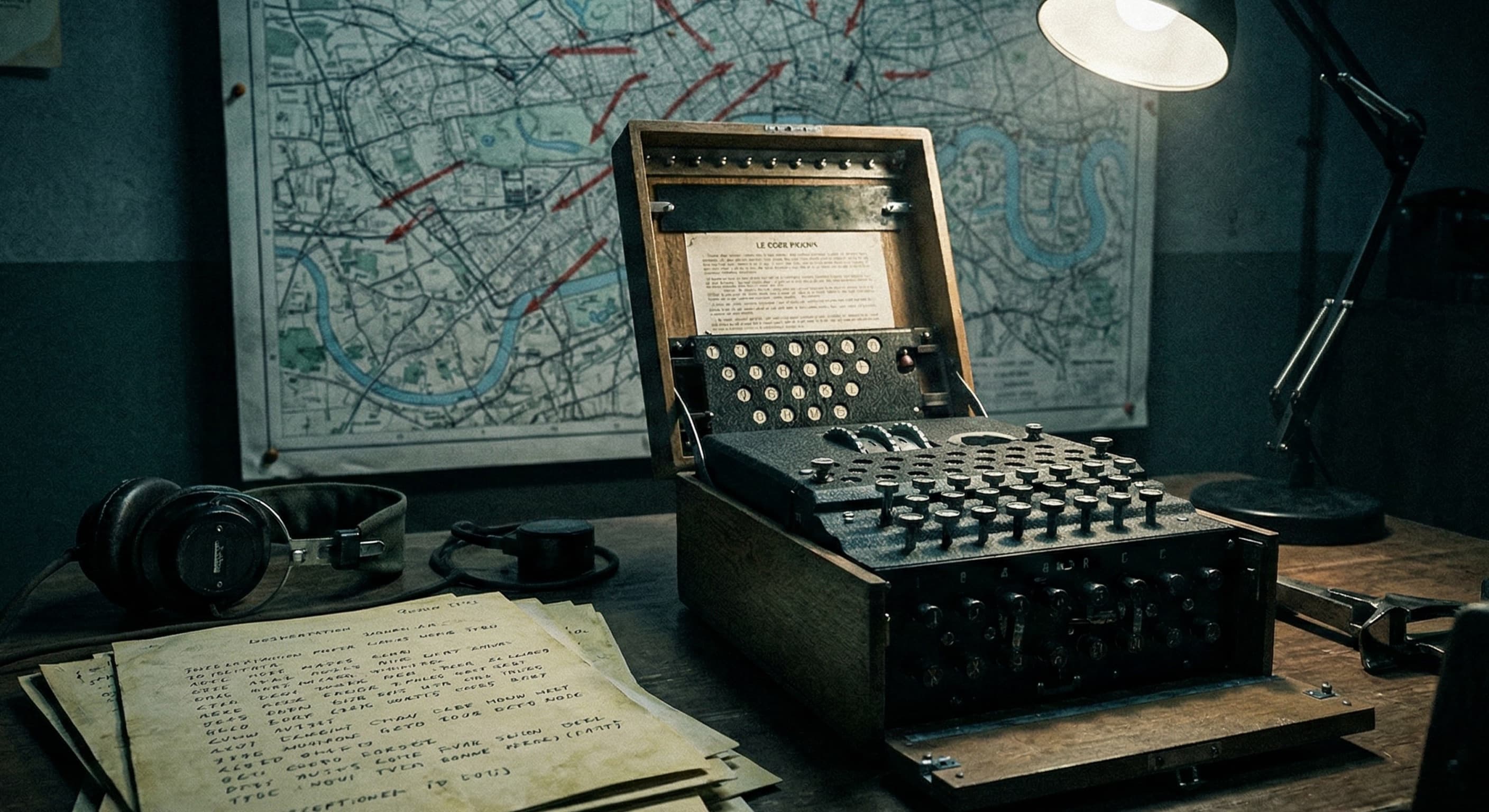
At 3:47 in the morning on March 14, 1943, the Y listening station intercepts a high priority German transmission. It is encoded with a variant of the Enigma machine nobody has seen before, and military intelligence believes it carries the coordinates of a V2 launch site aimed at London, with the launch scheduled inside forty eight hours. Your team is gathered in Hut 8, a windowless wooden building that smells of stale tobacco and carbon paper, and the commander puts the intercept on the table with a single sentence about what happens if you fail. The second problem is worse than the first. Recent leaks suggest somebody inside the Ultra operation is feeding the enemy, either at Bletchley itself or in one of the small circles that receive its output. So you are not only racing a launch window, you are working alongside someone who wants you to fail. That double pressure is what gives this file its particular flavor, and it is why the two hour runtime feels shorter than it is.
What is in the folder
Ten exhibits and five puzzles. The intercepted Kestrel-7 transmission itself. A partial page from an Enigma codebook. An MI5 report listing the suspects currently under surveillance. A strategic map of the candidate launch sites. A decoded fragment of an earlier message, which is the bridge between the technical work and the human one. The interrogation of a German private. An internal memorandum from a British captain. A telegram from the French Resistance. A page of The Times from March 10, 1943. And an aerial reconnaissance report. The file also gives you a documented timeline running back to autumn 1942: two liaison missions to Lisbon, a restricted intelligence note circulated to exactly three holders in November, and the abrupt German protocol change in December that happened to abandon precisely the networks that note described. Each exhibit carries an investigator box at the foot of the page that asks you the right question without ever handing you the answer.
How the session runs
There is no host and no referee. Everyone plays, and the file runs the evening. You read the briefing together, work through the exhibits in any order, solve the five puzzles by cross referencing documents against each other, then deliberate: the coordinates of the launch site, the identity of the mole, and the evidence for both. Only then do you open the solution. The method the file teaches is counterintelligence rather than detective work. For every name on the MI5 list you ask three questions. Did they know, meaning did they have access to the leaked information and from what date. Could they, meaning where were they at the key moments and especially on the night of March 13. And did they lie, meaning does their statement survive contact with the logs and records in the other exhibits. The file states the rule bluntly: a suspect is not guilty for being odd and not innocent for being likable. Only the cross checks count.
Four stars out of five, and what that really means
This is a hard file and it should be bought as one. Four out of five here means genuine decoding with pencil and paper, a timeline you will need to write out, and a conclusion you reach by elimination rather than by spotting a single damning document. Nothing in the folder names the mole. The name is produced by crossing dates, access and contradictions across several exhibits, which is exactly how the real work was done. Budget the full two hours and expect the middle stretch to feel slow, because it is supposed to: that is where the timeline gets built. A set of progressive clues sits at the back so a stuck table can take one nudge rather than surrendering. Two experienced players will finish inside two hours. A table of four with no puzzle background should plan for the whole evening and not feel bad about taking three clues along the way.
The right table for this one
Two to six players. It is superb for two people who like hard puzzles and want something better than a crossword, and it is the strongest file in the range for a group of colleagues, because the cross checking method is essentially structured analysis and everybody has a role in it. If you are looking for an activity that gets a team working the same problem from different documents, it does that more honestly than most exercises designed for the purpose, and the practical notes on /murder-mystery-team-building apply to running it with a work group. It also suits history readers, people who have visited Bletchley or read about it, and anyone who has ever wanted to try a substitution cipher with a real reason to finish it. Four players is the ideal number: enough hands for the documents, few enough that everyone stays inside the same conversation. Two works well too, provided you both enjoy being stuck for a while.
Who should not buy it
Do not buy this as your first case file. Start at three stars, learn how the cross referencing works, and come back. A beginner table that opens this one cold often stalls in the first thirty minutes and never recovers the momentum. Do not buy it for a group that wants to talk in character, because there are no characters here and nobody performs anything. Those guests want a murder mystery party from /murder-mystery-kits instead. Do not buy it for children, and be realistic about younger teenagers: the decoding is real work and the historical context assumes you know roughly what 1943 was. Avoid it as a background activity at a party, since it needs a clear table, good light and an uninterrupted two hours. And skip it if anyone in your group finds wartime material uncomfortable, because the stakes are civilian deaths in an air raid and the file does not soften that.
Practical tips for a good session
Print everything and lay it out flat. This is the file that suffers most from being read on a screen, because you will be comparing three documents at once and writing between them. Put out more paper and more pencils than you think you need. Give the codebook page and the intercepted transmission to two different people from the start, so the decoding proceeds in parallel with the reading. Build the timeline on one shared sheet where everyone can see it rather than in individual notebooks, since the whole solution lives in that timeline. Use the progressive clues one at a time with ten minutes of discussion between them. Set a two hour timer if your group enjoys pressure, and skip it if they do not, because the file is demanding enough without it. Low light and some 1940s music help the mood. And before you open the solution, write down not just the mole and the coordinates but the reason each other suspect is cleared.
Frequently asked questions
How many players and how long?+
Two to six players, about two hours. Four is the ideal number: enough people to split the documents without anyone falling outside the conversation. Two experienced puzzle solvers will finish inside the two hours, while a beginner table should allow the full evening.
How difficult is The Enigma Code?+
Four stars out of five, which is genuinely hard. There is real decoding with pencil and paper, a timeline you will need to write out, and no document that names the mole on its own. Progressive clues are included so a stuck table can take one nudge at a time.
Do I need to know anything about ciphers or the war?+
No. Everything you need is inside the folder, including the codebook page and the method for testing each suspect. Prior interest in the period makes it richer, but the puzzles are self contained and no outside research is required or rewarded.
What do I get for $39?+
A print ready PDF delivered in seconds, nothing shipped. It contains the codebreaker guide with the counterintelligence method, the mission briefing and timeline, ten pieces of evidence, five puzzles, a set of progressive clues, and the full sealed solution.